
Our Not‑So‑Normal School Morning Routine
A “Normal” Morning at Our House
If you’ve read the story behind Housebound Husband, you know our world got smaller one decision at a time. This is what a “normal” school morning actually looks like inside that life.
People talk about “morning routines” like they’re a checklist you design once and follow forever. Ours shifts every day based on one simple variable: who slept where and how much.
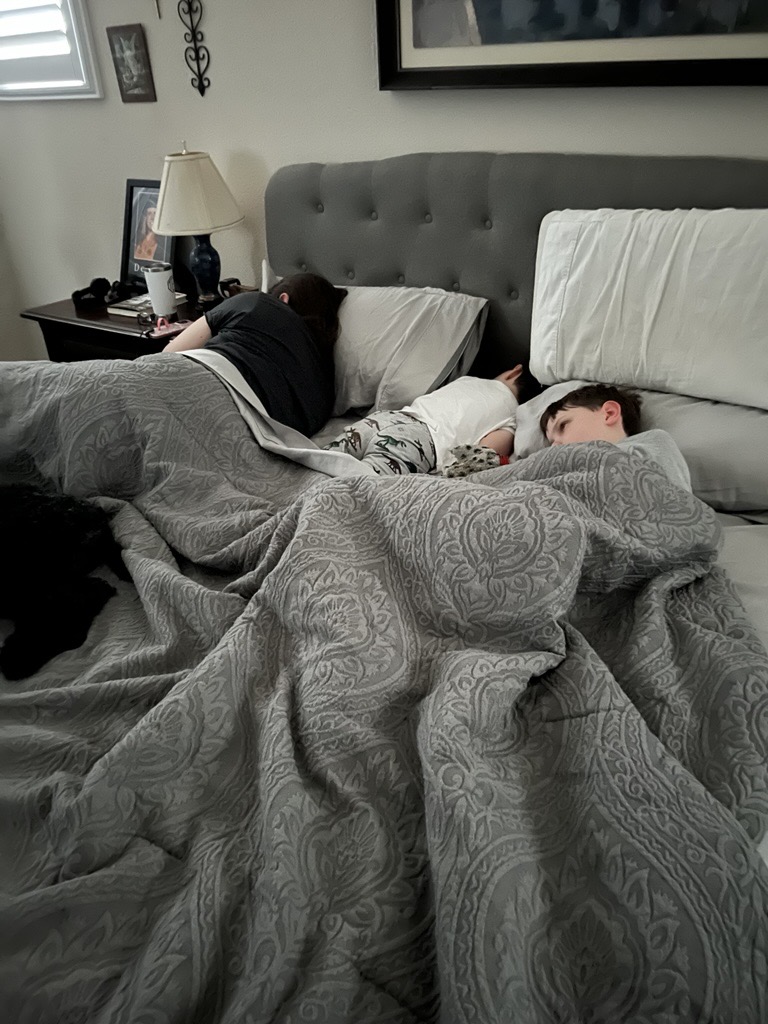
On the good nights, everyone makes it to their own bed and gets something close to a full night’s sleep. Those are the days our routine has a fighting chance.
The alarm and the four‑snooze rule
Most mornings start with my wife’s phone screaming like a sinking submarine somewhere on her nightstand. We’ve negotiated a four‑snooze rule: four chances to pretend we still have time before it officially becomes “get out of bed or else we’re late.”
If I make it out of bed first, I usually shuffle to my recliner, turn on the news, and let my brain boot up slowly. My wife wanders to the kitchen and starts the coffee. We don’t say much. Between the news and our phones, the house is quiet in that heavy, half‑asleep way where everyone knows what’s coming next but no one wants to start it yet.
Around 7:20, one of us finally sighs, stands up, and heads upstairs. That’s the moment our “routine” stops being theoretical and turns into real life.
Waking Logan: the reluctant morning person
Our youngest, Logan, is not a morning person. Some days he’s a walking yawn; other days there are full‑on tears before his feet even hit the floor. Just getting him to come downstairs can feel like winning a small war.
Most mornings my wife is the one who coaxes him into the day. She’ll meet him where he is—sometimes that means making his breakfast just the way he likes it, sometimes it means “cuddling” him on the couch until his emotions stop swinging quite so hard. It’s less “rise and shine” and more “rise and try again.”

Waking Mark: the true wildcard
Our oldest, Mark, is the wildcard in this whole operation.
He does not want to get up and go to school. If he had his way, every morning would be “stay in Mark’s bed,” and he’ll repeat that phrase over and over like a broken record. We’ve learned that the more we negotiate, the worse it goes, so he does best with firm, clear expectations—what I jokingly call the “iron fist” version of parenting.
The trick that’s worked best this year is something we call the Mommy Crane. My wife quite literally scoops him out of bed in a playful but non‑negotiable way, like a crane lifting cargo. He still asks to go back to bed a half‑dozen times, but we’ve become numb to that request and keep moving down the checklist. Some mornings he gets anxious or upset, and he’s even tried to make himself throw up to escape the day, but we stay calm, keep the steps the same, and push through.
The school split: Mom taxi vs. Dad drop‑off
Once the boys are at least vertical and vaguely fed, we divide and conquer. One of us takes Logan to school, and the way he gets there changes the whole feel of the morning.
If my wife drives, she parks and walks him all the way to the front door. That’s his preference, and on those days the “Mom taxi” comes with extra hugs and a slower goodbye. The trade‑off is that she gets stuck in traffic and usually can’t leave until after 8:00, which means less time back at home before the rest of the day hits.
If I’m on duty, it’s straight through the car line: backpack, quick goodbye, door closes, and I’m already pulling away. It’s more efficient, but it’s also more abrupt. Those small differences—walk‑up versus drop‑off lane—quietly shape what the next hour looks like for all of us.
Getting Mark ready for his day
On the mornings when Logan gets the Mom taxi, I usually stay home with Mark. That’s our window to shift him from “I want to stay in Mark’s bed” to “I’m actually ready for school now.”
Practically, it looks like a lot of small steps: helping him get dressed, finding the right shirt that doesn’t bother him, and working in as many tickles as he’ll tolerate. Some days he leans into it and we move quickly; other days he melts down and recovery isn’t guaranteed. The longer the year went on, the fewer full‑scale meltdowns we had, but we never quite knew which version of the morning we were getting.
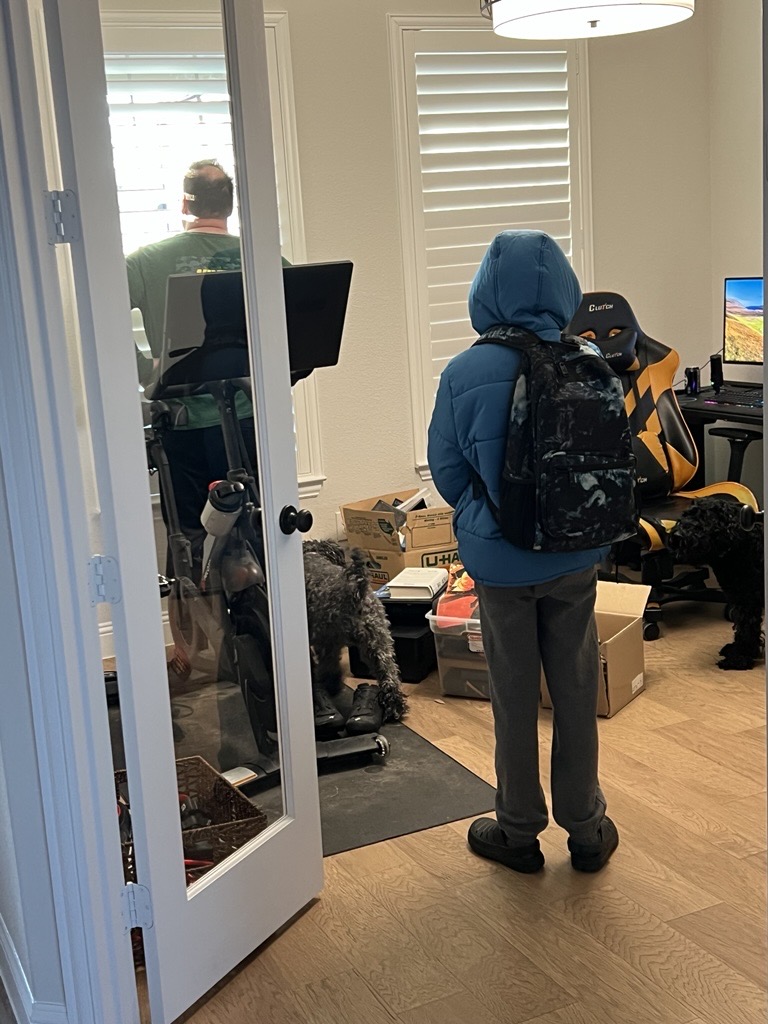
We’ve tried to wrap this part of the routine in predictability. We load his iPad into his backpack, help him put the backpack on, and then we all put our hands in and yell, “I am going to have a great day!” It’s a small thing, but that tiny moment of unity right before everyone scatters has become one of the anchors that holds our mornings together.
When “normal” doesn’t look normal
By the time both boys are out the door, it’s easy to forget how much work went into just getting to that point. From who slept where, to the four‑snooze alarm, to the Mommy Crane and our “I am going to have a great day” huddle on the porch, none of it looks like the calm, color‑coded routines you see on parenting reels.
But that’s kind of the point.
Our mornings aren’t smooth because everything is under control. They’re survivable because we’ve built a handful of small anchors into the chaos—coffee in the quiet, the same wake‑up phrases, predictable steps, a silly family chant before everyone scatters. On the outside it might look messy, inconsistent, even a little unhinged. On the inside, it’s the rhythm that keeps our house from spinning completely off its axis.
If you’re in a season where your family’s “normal” doesn’t look like anybody else’s, you’re not alone. Start with one tiny anchor—a phrase, a ritual, a step you repeat every morning—and build from there. And if you want to know how we ended up with this version of normal in the first place, you can always go back to the beginning and read “The Story Behind Housebound Husband.”